A Policy Plan Is Not an Operating Routine
A policy plan sets direction; an operating routine makes action repeatable. Learn what procedures, roles, records, and feedback are needed to carry it out.
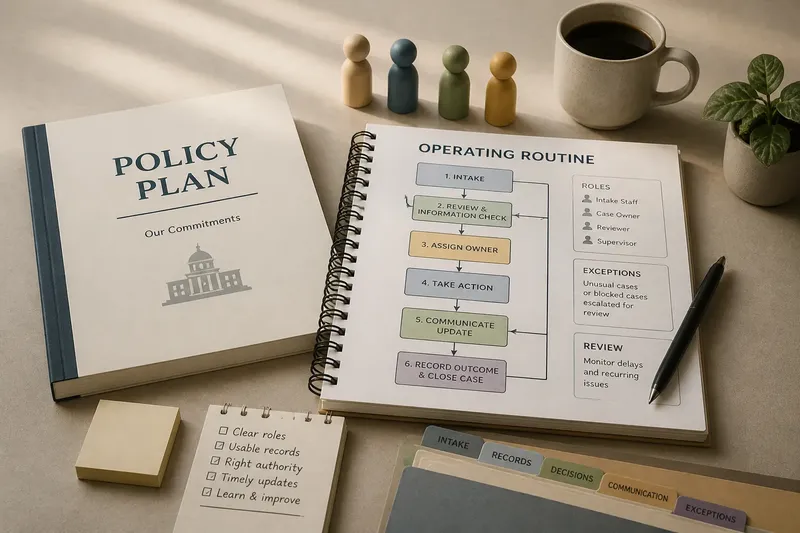
How does a policy plan become consistent practice? A policy plan sets direction, but an operating routine tells people what to do when a request arrives, a decision is due, or an exception appears. Without that translation, a document can be clear on paper and still leave each office to improvise.
This distinction matters after a policy decision has been made. The question is no longer only what the policy intends. It is how staff recognize a case, assign responsibility, act within their authority, record what happened, and handle the next case in a comparable way.
What is the difference between a policy plan and an operating routine?
A policy plan states the intended direction and the commitments behind it. An operating routine turns those commitments into recurring work: a sequence of decisions, named roles, usable records, and a way to resolve departures from the usual path.
For example, a plan might say that residents should receive clear responses to service requests. A routine has to specify where a request is received, who checks that it contains enough information, who answers it, and what happens if the responsible unit cannot respond directly. The plan describes the destination; the routine is the route staff can follow on an ordinary Tuesday.
A routine need not be a rigid script. Staff may need judgment, especially when cases differ. But judgment works better when its boundaries are clear: what can be decided locally, what requires review, and what must be recorded so another person can understand the decision.
Why does a written policy produce different practice across offices?
Because a written policy does not assign every task, settle every handoff, or make missing resources appear. Different offices may interpret broad terms differently, use separate records, or have different ways of deciding which work takes priority. Even conscientious staff can produce inconsistent practice when the operating conditions differ.
Ambiguous responsibility is a common source of drift. If a policy says that a department will “coordinate” a response, staff still need to know who initiates contact, who owns the case while it is pending, and who tells the resident what is happening. “Coordinate” sounds tidy; in a procedure, it is usually a verb waiting for a subject.
Capacity also matters. A routine that assumes access to a specialist, a shared case system, or uninterrupted staff time may not fit every location. When the required support is unavailable, employees may create local workarounds. Those workarounds can keep work moving, but they may also make decisions harder to compare or explain.
What belongs in an operating routine?
Include only enough detail to make the work repeatable and accountable. A useful routine usually clarifies:
- Entry point: where a request, referral, or case first arrives.
- Ownership: which role is responsible at each stage, including during a handoff.
- Decision authority: which choices staff may make and which require approval.
- Information: what must be checked or recorded before action proceeds.
- Exceptions: how staff flag unusual cases and who helps resolve them.
- Communication: who updates the person affected and what they are told.
- Review: how the organization notices delays, repeated confusion, or inconsistent decisions.
These are working questions, not a demand for a thick manual. A short workflow, a role table, and a sample record may be more useful than another statement of principle. Each should answer a distinct question, and staff should be able to find the relevant part while doing the work.
How can a policy team check whether a routine is usable?
Ask the people who will carry it out to walk through a normal case and a case that does not fit neatly. The aim is to expose gaps in ownership, information, and authority before they become local habits. A procedure that makes sense only to its author is not yet operational.
Say a city office adopts a policy to respond to resident reports of missed waste collection. Imagine the written direction says reports will be reviewed and resolved, but does not name who checks the address or who contacts the contractor. The team could map the route from intake to closure, assign those actions to roles, and add a place to record the outcome. The expected observable result is that staff can identify the next responsible person and residents can receive a coherent update, even when the first review does not settle the report.
Then ask staff to explain what happens when the usual path fails. Can they identify a supervisor or another route for an unresolved case? Can they distinguish a policy exception from a simple missing detail? If not, revise the routine where the uncertainty occurs rather than adding general language elsewhere.
Who should maintain the routine after it is written?
The operational owner should be identifiable, even when several units contribute. That owner may coordinate revisions, gather questions from staff, and bring recurring problems to the people authorized to change the process. A document with no maintenance owner can become a record of how the work used to happen.
Staff who perform the work should have a practical way to flag defects: an unclear form field, a handoff that routinely stalls, or an exception with no stated route. Managers can sort those observations into issues that need clarification, training, added capacity, or a policy decision. Not every difficulty is solved by rewriting the procedure.
Changes should also be visible. If a routine is updated, note what changed and make sure the current version is easy to locate. Otherwise, two staff members may follow different instructions while each believes they are using the official one.
How should leaders respond when the routine does not fit?
First identify the kind of mismatch. A case may be unusual but still covered by existing authority; the routine may be unclear; or the policy itself may leave a decision unresolved. These are different problems, and treating all of them as staff error makes the record less useful.
Where staff have discretion, state its limits and provide a route for advice when a choice could materially affect someone. Where the process cannot handle a recurring situation, the operational owner should bring that pattern to the appropriate decision-makers. Frontline work can reveal a design gap, but staff should not be expected to settle a policy question by quietly inventing a rule.
What questions help distinguish a policy from a routine?
Does every policy need a written procedure?
Not every policy needs a separate manual, but any policy that creates recurring work needs a clear account of who does what and how exceptions are handled. That account may sit in a workflow, staff guidance, or an existing service procedure.
How much detail should an operating routine include?
Include detail that helps staff act, transfer responsibility, or explain a decision. Remove material that merely repeats the policy’s purpose without changing what someone does.
How can managers spot inconsistent implementation?
Look for repeated questions, different records for similar cases, unclear handoffs, and decisions that cannot be explained from the file. Those signals point to places where the routine may need clarification or support.
When should a routine be revised?
Revise it when responsibilities, authority, tools, or the work itself change, and when recurring cases reveal a gap. The main search question—how a policy plan becomes an operating routine—has a practical answer: make the work visible, assign its handoffs, and give staff a way to raise what the written process cannot resolve.
Keep the routine close to the work it governs. A useful procedure is not the one with the most pages; it is the one a staff member can consult at the moment responsibility changes, then leave a record that lets the next person continue without guessing.